When we were here over Christmas I had formed the view that Auckland was somewhat scrappy but determined I would seek out some of the gems suggested by my guidebook were lurking there. I set off from our hotel along Queen Street, rising away from the business centre and up to Myers Park. In the 1900s this area of Auckland had been described as 'an unwholesome spot, a quarter of slum shanties and rubbish tips'. Myers, a local businessman and ex-mayor, bought, cleared and redeveloped 'this unsightly gulley' and turned it into this delightful park.
With at one end a copy of Michelangelo's 'Moses'. This had been donated by a local department store, the original having been produced in the early 16c for the tomb of pope Julius II.
And at the other end of the park the 'Five Rams, donated by the sister Chinese city of Guangzhou to celebrate their 10 year anniversary in1999.
Then back down Queen Street to the civic heart of the city, Aotea Square, and the Town Hall.
Off to Khartoum Place, a pretty little square with tiling celebrating the suffragettes - NZ women were the first in the world to win the vote.
Along Wellesley Street to the Auckland Art Gallery, behind which...
...is Albert Park, another delightful green area so close to the bustle of Queen Street. And beyond that...
...the University area with its Clock Tower currently undergoing refurbishment.
And as one heads back to Queen Street, another quiet corner of greenery and running water helping to build a picture of a less scrappy Auckland than the one I first saw.
Tuesday, 8 January 2013
Western Northland
In Russell we said goodbye to Matt, Denise and Neta. How grateful we are to Matt and Denise for all they have done to make this such a good trip for us. Lyall, Clodagh and I were to go across to the western coast, staying the night there before travelling south back to Auckland.
We first called at Kawakawa, famous for its artistic loos! Here they had indulged a local artist, who produced this unusually designed public convenience.
And some street furniture.
We drove across country and came to the Hokianga river with its wide inlets and bays and took the ferry across to Rawene, where we had booked accommodation at what described itself as a 'boutique hotel'. If 'boutique' means large, rambling, rundown, stuffed full of dusty, old furniture and effects it's a fair description but not quite the way it appeared on its website.
The rest of Rawene looked equally rundown with almost every other property up for sale. They looked as if they had been on the market for a long time and probably had no chance of finding a buyer. The elderly couple, who run our boutique hotel and whose two sons have fled to Australia, must feel trapped there. The best part of Rawene for me was a walk along a path through mangroves on the edge of the river.
The only place to have dinner was the other hotel (up for sale), where we suffered very slow service and a poor Sunday roast. The owner couldn't take the pressure of a dozen diners. We couldn't get out of Rawene quickly enough and left before 8.00 next morning, declining the offer of breakfast.
We drove across to the coast and followed it south and through a long stretch of the Waipoua forest, passing large tree ferns and massive kauri trees. A good link, because later we stopped at the impressive Kauri museum in Matakohe. There we learned of the long life span of the kauri tree, displayed by this example, which was 860 years old when it was cut down in 1960.
But very many have been cut down earlier than that and the museum records the devastation. It also demonstrates the methods and equipment used to turn logs into timber in the Steam Sawmill with moving saws, belts, pulleys and steam engines.
There are displays of ancient pieces of trees carved and polished to works of art...
...fine Kauri furniture...
...and Kauri gum carved and polished to portray a Mauri chief. The gum seeps from the trees over many years and was an important element in making paints and varnishes. The museum portrays the rough, tough industry that developed for digging out the gum, which in some cases had seeped out of earlier generations of Kauri forests, which had died down and new ones grown and died down several times over millennia.
We left the fascinating Kauri museum and drove back to Auckland where Lyall dropped us off at our hotel. We redeemed from their storage two cases full of unwanted items including winter clothing for our flight in a couple of days time to Vancouver.
But still time for a walk in the evening sunshine.
And dinner in the hotel's top floor restaurant looking out over Auckland harbour.
We first called at Kawakawa, famous for its artistic loos! Here they had indulged a local artist, who produced this unusually designed public convenience.
And some street furniture.
We drove across country and came to the Hokianga river with its wide inlets and bays and took the ferry across to Rawene, where we had booked accommodation at what described itself as a 'boutique hotel'. If 'boutique' means large, rambling, rundown, stuffed full of dusty, old furniture and effects it's a fair description but not quite the way it appeared on its website.
The rest of Rawene looked equally rundown with almost every other property up for sale. They looked as if they had been on the market for a long time and probably had no chance of finding a buyer. The elderly couple, who run our boutique hotel and whose two sons have fled to Australia, must feel trapped there. The best part of Rawene for me was a walk along a path through mangroves on the edge of the river.
The only place to have dinner was the other hotel (up for sale), where we suffered very slow service and a poor Sunday roast. The owner couldn't take the pressure of a dozen diners. We couldn't get out of Rawene quickly enough and left before 8.00 next morning, declining the offer of breakfast.
We drove across to the coast and followed it south and through a long stretch of the Waipoua forest, passing large tree ferns and massive kauri trees. A good link, because later we stopped at the impressive Kauri museum in Matakohe. There we learned of the long life span of the kauri tree, displayed by this example, which was 860 years old when it was cut down in 1960.
But very many have been cut down earlier than that and the museum records the devastation. It also demonstrates the methods and equipment used to turn logs into timber in the Steam Sawmill with moving saws, belts, pulleys and steam engines.
There are displays of ancient pieces of trees carved and polished to works of art...
...fine Kauri furniture...
...and Kauri gum carved and polished to portray a Mauri chief. The gum seeps from the trees over many years and was an important element in making paints and varnishes. The museum portrays the rough, tough industry that developed for digging out the gum, which in some cases had seeped out of earlier generations of Kauri forests, which had died down and new ones grown and died down several times over millennia.
We left the fascinating Kauri museum and drove back to Auckland where Lyall dropped us off at our hotel. We redeemed from their storage two cases full of unwanted items including winter clothing for our flight in a couple of days time to Vancouver.
But still time for a walk in the evening sunshine.
And dinner in the hotel's top floor restaurant looking out over Auckland harbour.
Sunday, 6 January 2013
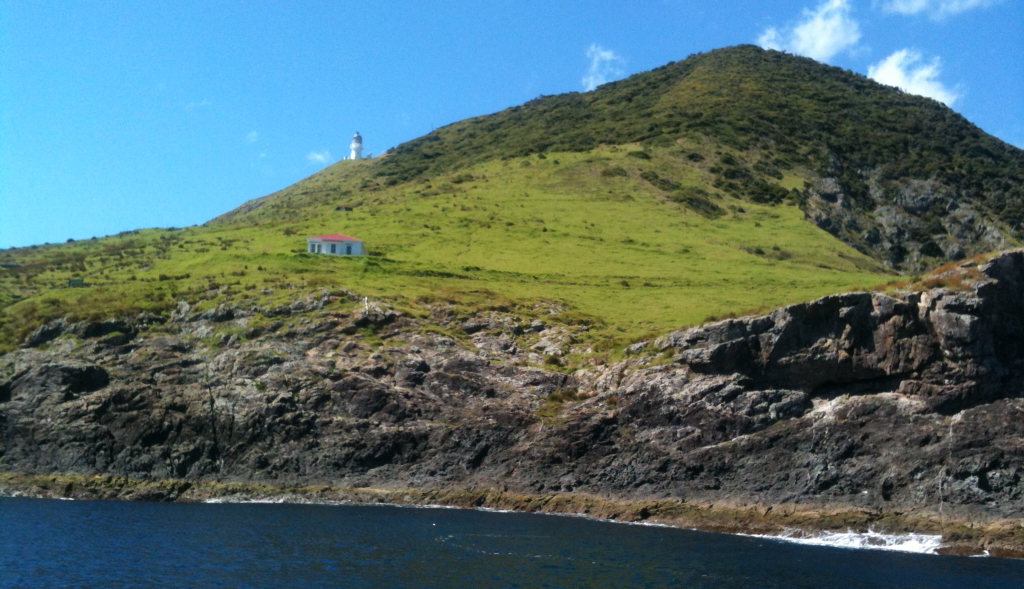
Boat trip to the Hole in the Rock
Clodagh and I went on a boat trip in the Bay of Islands, which had started from Paihia and we picked it up from the Russell Wharf.
We went at great speed across the Bay, which consists of about 150 islands, but then slowed for a sight of Cook's Bay. Captain Cook was the first European to come here in 1769.
He is said to have climbed to the top of what is now known as 'Cook's Lookout' and given the bay the name 'Bay of Islands'.
It became a favourite place of harbour for whalers.
We passed many beautiful and unoccupied islands.
And on some the occupation looked rather lonely...
...and on others the occupation looked a little grander.
Then the highlight of our trip, the dolphins. We slowed in an area where they jumped and...
...frolicked around our boat. A great sight.
We then got to the 'Hole in the Rock', which boats can often go through
but it was too rough for our boat to attempt it.
We then sped back from one hole to another. Russell had once been known as the 'Hell-hole of the Pacific', during the time it was frequented by the bay's whalers.
In the evening a walk round to Long Beach.
That was followed by a farewell dinner back in Russell at the Duke of Marlborough restaurant, courtesy of Lyall, with Simon and John and all the family, including John's parents.
The end of an interesting and very enjoyable stay in what must be one of the most beautiful of the world's holiday locations. One can well understand why Simon and John wanted to hold their wedding here. What a memorable week!
We went at great speed across the Bay, which consists of about 150 islands, but then slowed for a sight of Cook's Bay. Captain Cook was the first European to come here in 1769.
He is said to have climbed to the top of what is now known as 'Cook's Lookout' and given the bay the name 'Bay of Islands'.
It became a favourite place of harbour for whalers.
We passed many beautiful and unoccupied islands.
And on some the occupation looked rather lonely...
...and on others the occupation looked a little grander.
Then the highlight of our trip, the dolphins. We slowed in an area where they jumped and...
...frolicked around our boat. A great sight.
We then got to the 'Hole in the Rock', which boats can often go through
but it was too rough for our boat to attempt it.
We then sped back from one hole to another. Russell had once been known as the 'Hell-hole of the Pacific', during the time it was frequented by the bay's whalers.
In the evening a walk round to Long Beach.
That was followed by a farewell dinner back in Russell at the Duke of Marlborough restaurant, courtesy of Lyall, with Simon and John and all the family, including John's parents.
The end of an interesting and very enjoyable stay in what must be one of the most beautiful of the world's holiday locations. One can well understand why Simon and John wanted to hold their wedding here. What a memorable week!
Friday, 4 January 2013
The wedding events
Simon and John organised events over 3 days, the central item being the ceremony itself but being preceded by an evening welcome and followed by a lunch farewell. The evening event took the form a of a well organised quiz, which everyone seemed to enjoy. The winning team was seen using Google extensively but no one seemed to mind. As many of the questions were inevitably NZ oriented with a number about gays, it was not always easy to contribute but a good way of getting to know some of the other guests.
In between events I did some walking and again climbed Flagstaff Hill, this time to find a giant sundial on top but unfortunately no sun.
The weather forecast over this period was not at all good.
The wedding ceremony had been due to take place in the open in the beautiful garden of the Pompellier Mission - somewhat ironic that this gay wedding should take place at what was originally the French Catholic Mission HQ. However, perhaps some higher authority decided to intervene. The heavens opened, the rains poured down and the venue had to be changed to the Town Hall. Fortunate for Neta and us, as our apartments were immediately across the road from there.
Simon has a reputation as a perfectionist and and worked to a detailed timeline of when everything was due to happen. Guests were asked to arrive from 3.30 for the 4 p.m. start. When we arrived the hall was already fairly full and Clodagh and I sat a few rows back. Neta had a seat in the front with the family. Despite the detailed timeline, in true bridal fashion, they arrived 15 minutes late. The hour long ceremony was then conducted by Dr Kim Jewell Elliott and she had much to say throughout about the love that Simon and John have for each other.
There were readings and prayers from friends and their sisters, Helen, Honor and Trish. There was a water ritual, where Simon and John washed each others hands, and Declarations of Intent. Then there was a 'Handfasting' where their mothers bound their hands together and their fathers loosened them to represent their past relationships with their parents.
Simon and John then declared vows to each other - much longer than the vows we are normally used to. More familiarly, this was followed by an exchange of rings, the Celebrant made a pronouncement of their union and the register was signed,
During the ceremony heavy rain was heard on the tin roof but had cleared to enable us to go outside for drinks and canopes while the hall was rearranged. Then back in for speeches from both Simon and John, some of their friends and from both mothers. We were then more than ready for the buffet meal and were seated next to Helen's cousin, Simone and her husband, Chris, who we had met in the UK at Olivia's Christening 5 years ago. The meal was followed by a ceilidh, by which time the noise was too much for me and I escaped across to our apartment.
More walking over Flagstaff Hill and down to Tapeka Point, a pretty hamlet and beach at the head of the peninsular.
But got wet walking back.
Improved weather for the final lunch event at the house where Matt and Denise and the family were staying. There is a great view down their garden and to Long Beach, which is the beach most popular to those staying in Russell.
We said goodbye to those leaving immediately after, including Helen and Olivia.
In between events I did some walking and again climbed Flagstaff Hill, this time to find a giant sundial on top but unfortunately no sun.
The weather forecast over this period was not at all good.
The wedding ceremony had been due to take place in the open in the beautiful garden of the Pompellier Mission - somewhat ironic that this gay wedding should take place at what was originally the French Catholic Mission HQ. However, perhaps some higher authority decided to intervene. The heavens opened, the rains poured down and the venue had to be changed to the Town Hall. Fortunate for Neta and us, as our apartments were immediately across the road from there.
Simon has a reputation as a perfectionist and and worked to a detailed timeline of when everything was due to happen. Guests were asked to arrive from 3.30 for the 4 p.m. start. When we arrived the hall was already fairly full and Clodagh and I sat a few rows back. Neta had a seat in the front with the family. Despite the detailed timeline, in true bridal fashion, they arrived 15 minutes late. The hour long ceremony was then conducted by Dr Kim Jewell Elliott and she had much to say throughout about the love that Simon and John have for each other.
There were readings and prayers from friends and their sisters, Helen, Honor and Trish. There was a water ritual, where Simon and John washed each others hands, and Declarations of Intent. Then there was a 'Handfasting' where their mothers bound their hands together and their fathers loosened them to represent their past relationships with their parents.
Simon and John then declared vows to each other - much longer than the vows we are normally used to. More familiarly, this was followed by an exchange of rings, the Celebrant made a pronouncement of their union and the register was signed,
During the ceremony heavy rain was heard on the tin roof but had cleared to enable us to go outside for drinks and canopes while the hall was rearranged. Then back in for speeches from both Simon and John, some of their friends and from both mothers. We were then more than ready for the buffet meal and were seated next to Helen's cousin, Simone and her husband, Chris, who we had met in the UK at Olivia's Christening 5 years ago. The meal was followed by a ceilidh, by which time the noise was too much for me and I escaped across to our apartment.
More walking over Flagstaff Hill and down to Tapeka Point, a pretty hamlet and beach at the head of the peninsular.
But got wet walking back.
Improved weather for the final lunch event at the house where Matt and Denise and the family were staying. There is a great view down their garden and to Long Beach, which is the beach most popular to those staying in Russell.
We said goodbye to those leaving immediately after, including Helen and Olivia.
Thursday, 3 January 2013
Waitangi again and a walk to Haruru Falls

Today's was the highlight walk of the trip and warm and sunny all day.
I took the ferry to Paihia and walked along the coast to Waitangi. I'd so much enjoyed our trip here the day before, that I wanted to come back.
I then followed the long track from Waitangi to Haruru Falls, which first goes through fairly dense woodlands...
... crosses the Waitangi river...
... goes through an extensive mangrove swamp...
...through bamboos...
...back alongside the Waitangi river...
...and eventually to Haruru falls. Not high but a good horseshoe shape and a good target for the walk.
Then all the way back through woodland and bamboos and across river and swamp to Waitangi where, after a well needed lunch, I looked round again before walking back to Paihia for the ferry to Russell.
Russell and Waitangi
Lyall drove us north of Auckland to Russell through some heavy rain but beautiful country. We took a short car ferry across to the peninsula on which Russell stands and arrived early afternoon. We found our first floor studio apartment, looking out over Russell, which is small but with plenty of restaurants and cafes.
I walked up to Flagstaff Hill, so named to commemorate the four occasions in the 1840s when a Maori chief, Hone Heke, cut down the flagstaff flying the Union Jack. He felt his tribe had lost control to the British following the signing of the Waitangi Treaty. The place of the current flagstaff gives a good view over the harbour towards Paihia.
Next day we went to the Waitangi Treaty Grounds, which have a fascinating history. In 1831, due to growing lawlessness among Europeans and fears of French annexation, 13 Maori chiefs sought protection from King William IV. Hesent James Busby to New Zealand as the British Resident. He arrived in 1833 and built a small house on land he bought at Waitangi.
The house was extended over the years with wings at the rear enclosing a courtyard. Busby attempted to act without authority, land transactions continued that defrauded the Maori and the British government decided to intervene. William Hobson was appointed consul under the authority of the Governor of New South Wales, George Gipps. He was instructed to obtain sovereignty over all or part of New Zealand and becomes Gipps' Lieutenant-general. He effectively replaced Busby.
Private land purchases from the Maori were prohibited and a treaty was drawn up. This was discussed with 500 Maori chiefs and the Treaty was signed on 6th February 1840. It was an historic occasion and is marked as a public holiday in New Zealand. Hobson proclaimed British sovereignty over all New Zealand (the North Island under the Treaty and the South by discovery), but conflicts continued for decades after.
James Busby had acquired more than 10,000 acres but apparently overextended himself and went bankrupt - not an uncommon story today! There were arguments about the true ownership of the land, but in 1932 Lord Bledisloe bought the house and surrounding land and gifted it to the people of New Zealand, who have free entry.
A Maori Meeting house was built near the old house, which is now a museum.
A Maori war canoe is housed near the beach.
Waitangi is a truly beautiful place and is immaculately kept. It captures so well the struggles between the Maori and Europeans (the Pakeha) in the history of New Zealand.
I walked up to Flagstaff Hill, so named to commemorate the four occasions in the 1840s when a Maori chief, Hone Heke, cut down the flagstaff flying the Union Jack. He felt his tribe had lost control to the British following the signing of the Waitangi Treaty. The place of the current flagstaff gives a good view over the harbour towards Paihia.
Next day we went to the Waitangi Treaty Grounds, which have a fascinating history. In 1831, due to growing lawlessness among Europeans and fears of French annexation, 13 Maori chiefs sought protection from King William IV. Hesent James Busby to New Zealand as the British Resident. He arrived in 1833 and built a small house on land he bought at Waitangi.
The house was extended over the years with wings at the rear enclosing a courtyard. Busby attempted to act without authority, land transactions continued that defrauded the Maori and the British government decided to intervene. William Hobson was appointed consul under the authority of the Governor of New South Wales, George Gipps. He was instructed to obtain sovereignty over all or part of New Zealand and becomes Gipps' Lieutenant-general. He effectively replaced Busby.
Private land purchases from the Maori were prohibited and a treaty was drawn up. This was discussed with 500 Maori chiefs and the Treaty was signed on 6th February 1840. It was an historic occasion and is marked as a public holiday in New Zealand. Hobson proclaimed British sovereignty over all New Zealand (the North Island under the Treaty and the South by discovery), but conflicts continued for decades after.
James Busby had acquired more than 10,000 acres but apparently overextended himself and went bankrupt - not an uncommon story today! There were arguments about the true ownership of the land, but in 1932 Lord Bledisloe bought the house and surrounding land and gifted it to the people of New Zealand, who have free entry.
A Maori Meeting house was built near the old house, which is now a museum.
A Maori war canoe is housed near the beach.
Waitangi is a truly beautiful place and is immaculately kept. It captures so well the struggles between the Maori and Europeans (the Pakeha) in the history of New Zealand.
Subscribe to:
Posts (Atom)